SOLUTION · WEBSITES AND LANDING PAGES
Website for a medical or dental practice
A practice website has one concrete job: a patient who finds you on Google or through a referral should understand what you treat, trust who will treat them and know how to book in under a minute. I build it with services explained in plain language, the doctor's background and credentials, location and a direct path to WhatsApp, phone or the booking system, taking care of what the law asks of healthcare advertising and patient data.
What’s happening today
Many practices rely on referrals and a social media profile. That works until a new patient searches for the procedure or specialty on Google and finds another doctor whose site explains what they do better. An Instagram profile does not answer the questions a patient has before getting in touch: what you treat, where you are, how long a visit takes and how to book.
Other practices already have a website, but it is a generic template: copy that could belong to any clinic, stock photos, a form nobody checks and a phone number that does not open WhatsApp. Patients cannot find what they are looking for and end up calling to ask what the page should have answered, or they do not call at all.
Healthcare advertising is also regulated. In Mexico, article 83 of the General Health Law requires health professionals to state in their advertising the institution that issued their degree and their professional license number, and healthcare advertising is overseen by COFEPRIS. Promising results or publishing cure testimonials and before-and-after photos carelessly can get a practice into trouble and, above all, mislead patients.
And there is patient data. Mexico's Federal Law on the Protection of Personal Data Held by Private Parties treats health data as sensitive. A contact form that asks for the reason for the visit, sends it to a personal inbox and stores it without a privacy notice is an unnecessary risk.
How I’d solve it
- 01
Services explained the way patients search
Each important service or procedure gets its own section or page, written in the words patients use and not only in technical terms: what it is, who it is for, what the visit is like and what to ask. That way the site can appear in searches for each service, not only for the doctor's name.
- 02
The doctor and their credentials in plain sight
A section with the doctor's training, the institution that issued their degree, their professional license and, where it applies, their specialty license and board certification. It is what the law asks for and what builds the most trust with a patient who does not know you yet.
- 03
A short path to booking
Visible WhatsApp buttons with a prefilled first message, tap-to-call from a phone, a map and opening hours. If appointments live in a booking system, the button goes there. I measure clicks on each button so you know which pages generate the most contacts.
- 04
Responsible, reviewed advertising
No promised results and no comparisons that cannot be backed up. If the practice wants to show cases or photos, we plan it with the patient's consent and the review it needs. Clinical copy is reviewed by the doctor before publishing: my job is to make it clear and well organized, not to make medical claims.
- 05
Minimal data and a privacy notice
The form asks only for what is needed to reply, not a diagnosis. The site links the practice's privacy notice and messages go to a practice account, not a personal inbox. I help with the technical side of the notice; its legal wording is best reviewed by a specialist.
Example flow: a patient looking for a procedure
- The patient searches Google for the procedure and the city and lands on that service's page on the practice website.
- They read what the evaluation involves, who performs it and the doctor's license number, and see the location and hours.
- They tap the WhatsApp button, which opens the chat with a first message saying which service they are writing about.
- The front desk replies and books the evaluation; if the practice uses automatic reminders, the patient gets one before the visit.
- In the analytics dashboard, the practice sees how many WhatsApp clicks each page generated that month.
Related work
Frequently asked questions
What should a medical practice website include?
At a minimum: services explained clearly, the doctor's details with the institution that issued their degree and their license number, the address with a map, hours, a visible WhatsApp or phone button and the privacy notice. With that, a patient can decide and book without calling to ask the basics.
Can I publish testimonials or before-and-after photos?
Healthcare advertising is regulated, and patient photos are personal data that require consent. It is not something to publish without review. If you want to show cases, we plan it with written consent and without promising results, and the final decision is best made with legal advice.
How much does a website for a practice cost?
A small site with services, the doctor, location and WhatsApp usually falls in the range of a landing page or a small business site. It goes up if you want a page for each procedure, online booking or automatic reminders. I send a written scope with a fixed price per stage.
Can appointment reminders also go out by WhatsApp?
Yes, but it is a separate project from the website: it needs the official WhatsApp Business API, Meta-approved templates and a connection to your calendar. I explain it on the appointment reminder automation page.
Have you built websites for doctors before?
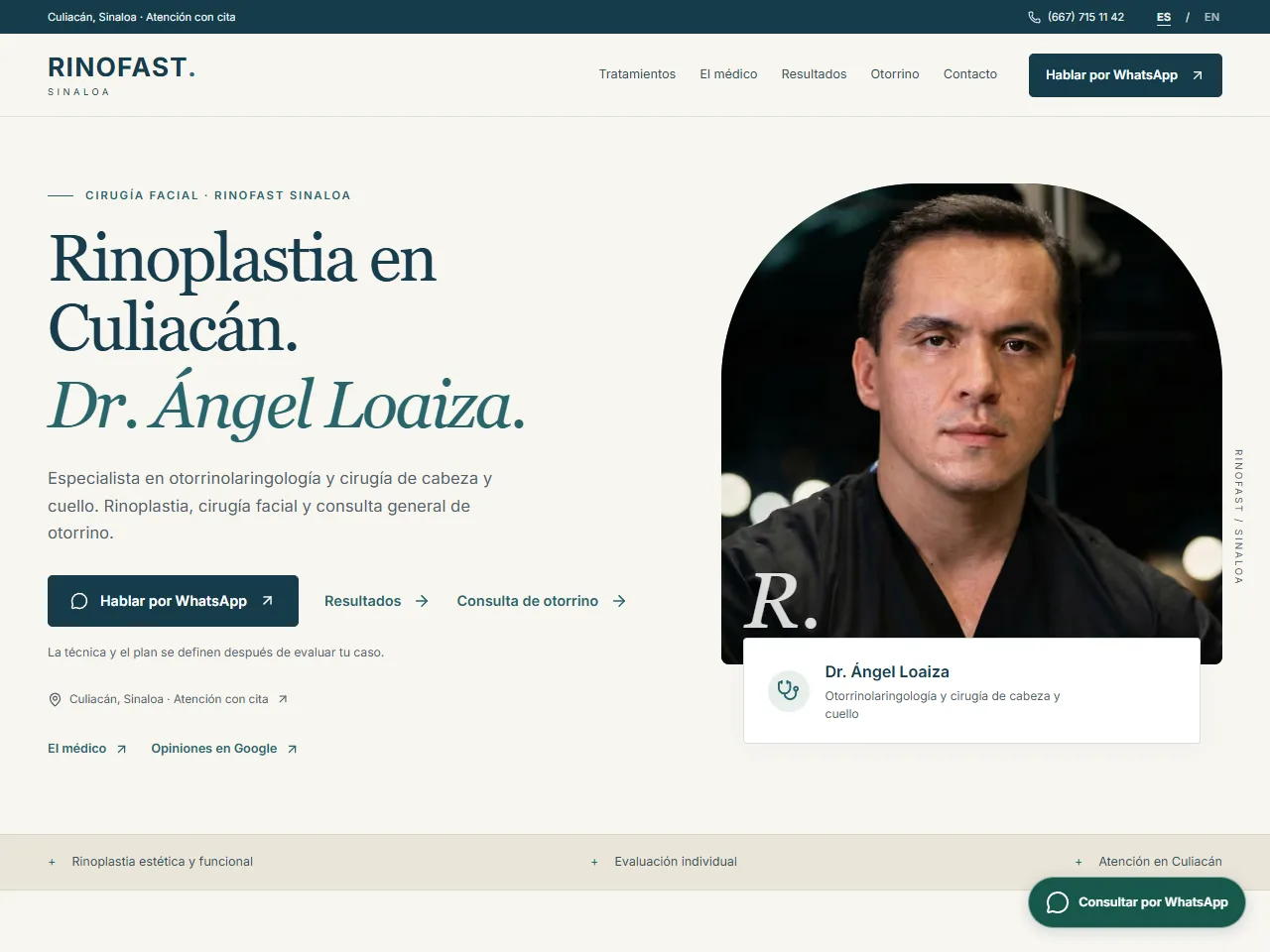
Yes. I built the site for Rinofast Sinaloa, an ear, nose and throat specialist in Culiacán: organized services, information about the specialist without promising clinical results, direct WhatsApp contact and tracking of contact clicks. It is live and you can review it.
This solution is part of my websites and landing pages service.
Want to talk it through?
If your situation sounds similar, tell me how you work today. I’ll tell you which part is worth automating or building first.